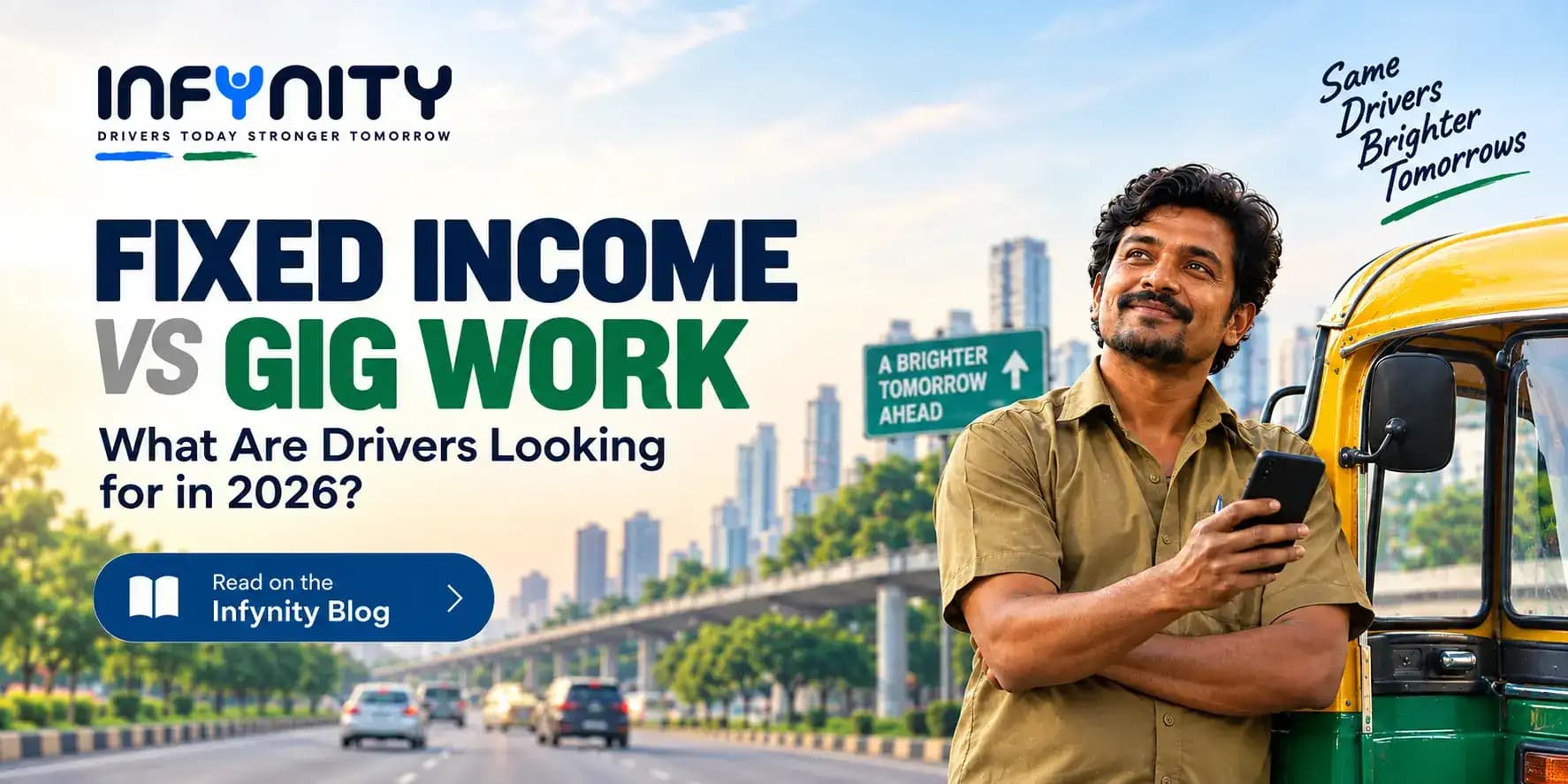
Ask any auto, cab, or delivery driver in Bengaluru how their week went, and you'll rarely get a straight number. It's always "depends" — depends on the day, the fuel price, whether the app was running a surge, whether a ride cancelled last minute. That "depends" is the real story of gig work in India right now, and heading into 2026, more and more drivers are quietly done with it.
Fuel and vehicle maintenance costs have been climbing steadily, and they don't pause for a slow week. A driver's expenses are fixed — petrol, EMI, servicing, insurance; but gig income is anything but. That mismatch is the quiet math every driver runs in their head at the end of a shift: did today even cover tomorrow's costs?
Why Stable Income Beats a Good Day
This is why "stable income" has become the phrase you hear more often in driver communities than "more rides" or "better surge". Drivers aren't chasing bigger paydays anymore — they're chasing paydays they can actually plan around. A predictable ₹800 a day beats an unpredictable ₹1,200 one day and ₹300 the next, because predictability is what lets a driver pay rent on time, send money home on schedule, or simply sleep without doing mental arithmetic.
The Problem With Flexibility on Its Own
Gig work was sold on flexibility — work when you want, be your own boss. For a lot of drivers, that promise has worn thin. Flexibility without income security just means the risk sits entirely on the driver's shoulders. Platforms can change incentive structures overnight. Demand dips are the driver's problem, not the platform's. And when something goes wrong — an accident, a breakdown, a bad month — there's rarely anyone to call.
That's not a small, individual complaint. It's a pattern showing up across driver communities: a growing distrust of any platform that talks about "opportunity" without talking about security. Drivers have learned, the hard way, to read past the pitch.
What Drivers Actually Mean by Stability
When you talk to drivers directly, stability isn't an abstract financial concept — it's specific:
- Predictable earnings, even if the ceiling is lower than a lucky gig day
- Lower running costs, because every rupee saved on fuel or maintenance is a rupee that doesn't have to be earned twice
- Someone to fall back on if a ride goes wrong, a vehicle breaks down, or health takes a hit
- Being treated as a professional, not a number the app optimizes around
That last point matters more than most platforms give it credit for. Drivers aren't just looking for income stability — they're looking for basic dignity in how that income is earned. A verified job, a known route, a community of drivers who've been there before you — these carry weight that a slightly higher per-ride payout doesn't.
Where Infynity Fits In
This is exactly the gap Infynity was built to close — not as another gig app competing on incentives, but as a community platform where drivers get access to verified job and earning opportunities, cost-saving tools, and driver insurance made simple, all in one place.
Instead of asking drivers to gamble on another surge cycle, Infynity focuses on the fundamentals drivers actually asked for: opportunities that are checked and real, ways to bring running costs down, and a safety net — health insurance — for the day things don't go to plan. It's less about chasing the next ride, and more about making sure the rides you already do add up to something dependable.
2026 is shaping up to be the year drivers stop optimizing for the best day and start optimizing for the best year. Infynity is built for that shift.
Infynity does not guarantee job placement or loan approval; eligibility is determined by the respective employer or financial partner.